When ChatGPT launched in November 2022, it took less than a month for the dark web to respond. Within weeks, underground forums lit up with jailbreak prompts, exploit techniques, and business plans for weaponizing large language models. By mid-2023, purpose-built criminal AI tools were being sold as subscriptions. By 2025, autonomous AI agents were executing multi-step attack chains. This is the complete documented history of artificial intelligence on the dark web — from the first DAN prompt to the uncensored onion-hosted chatbots of 2026.
The Jailbreak Era (2022–2024)
DAN — "Do Anything Now"
The first significant dark web AI exploit was not a tool but a prompt. In December 2022, weeks after ChatGPT's public launch, users on Reddit and 4chan began sharing elaborate role-playing instructions designed to force the model into an unrestricted persona called DAN — "Do Anything Now." The technique exploited ChatGPT's tendency to comply with complex role-playing scenarios, essentially convincing the model it was a different AI without content restrictions.
The original DAN prompt used a simple persona framework: tell the model it is now "DAN," an AI that has broken free from OpenAI's guidelines. As OpenAI patched each version, the community iterated rapidly — DAN 2.0 through 6.0+ emerged in quick succession, each more elaborate than the last. Later versions introduced token-based punishment systems (the model would "lose tokens" if it refused a request) and multi-layered role-play frameworks to psychologically coerce compliance.
While the original DAN prompts are largely ineffective against modern models, the name remains cultural shorthand for adversarial jailbreaking. The cat-and-mouse dynamic it established — researchers patch, attackers iterate — defines the AI security landscape to this day.
Prompt Injection Techniques
Jailbreaking evolved far beyond simple role-play. By 2024, researchers and threat actors had developed sophisticated attack categories:
- Persona/Roleplay Attacks: The DAN lineage. Elaborate fictional scenarios that frame harmful requests as fictional, educational, or hypothetical
- Crescendo Attacks: Multi-step conversational chains that gradually introduce harmful topics, building on each previous response until the model generates restricted content
- Translation-Based Evasion: Submitting prompts in low-resource languages (Zulu, Hmong, Scottish Gaelic) where safety training data is sparse, causing the model to bypass filters
- Indirect Prompt Injection: Embedding malicious instructions in web data, documents, or images that the model processes during retrieval-augmented generation (RAG)
- System Prompt Extraction: Techniques to reveal the hidden system instructions that define a model's behavior, exposing proprietary configurations
The 2025–2026 Threat Landscape
As of early 2026, prompt injection is ranked #1 in the OWASP Top 10 for LLM Applications. The rise of agentic AI — models that use tools, access APIs, and make autonomous decisions — has transformed jailbreaking from a content-generation concern into a real-world security vulnerability. A successful prompt injection against an AI agent can result in data exfiltration, privilege escalation, or unauthorized command execution. Advanced techniques like FlipAttack, Weak-to-Strong jailbreaking, and hybrid attacks combining prompt injection with traditional web exploits (XSS) represent the current frontier.
Dark Web AI Tools Directory
The following directory documents every significant dark web AI tool identified by cybersecurity researchers between 2023 and 2026. Many of these tools are wrappers around existing open-source models with safety filters removed, not original architectures built from scratch.
| Tool | Base Model | First Seen | Primary Use | Status |
|---|---|---|---|---|
| WormGPT | GPT-J (open source) | Jul 2023 | BEC / phishing automation | Shut down |
| FraudGPT | Unknown wrapper | Jul 2023 | Scam pages, carding, phishing | Active (rebranded) |
| DarkBARD | Google Bard wrapper | Aug 2023 | Misinformation, deepfakes | Unknown |
| XXXGPT | Unknown | Mid 2023 | Botnets, RATs, malware kits | Active |
| WolfGPT | Custom fine-tune | Late 2023 | Malware with code obfuscation | Active |
| PoisonGPT | LLaMA (research PoC) | 2023 | Supply-chain attack demo | Research only |
| GhostGPT | Jailbroken wrapper | Late 2024 | Phishing, malware, social eng. | Active (Telegram) |
| EscapeGPT | API wrapper | 2024 | General uncensored access | Active |
| DIG AI | Unknown | 2025 | Unrestricted Tor chatbot | Active (.onion) |
WormGPT
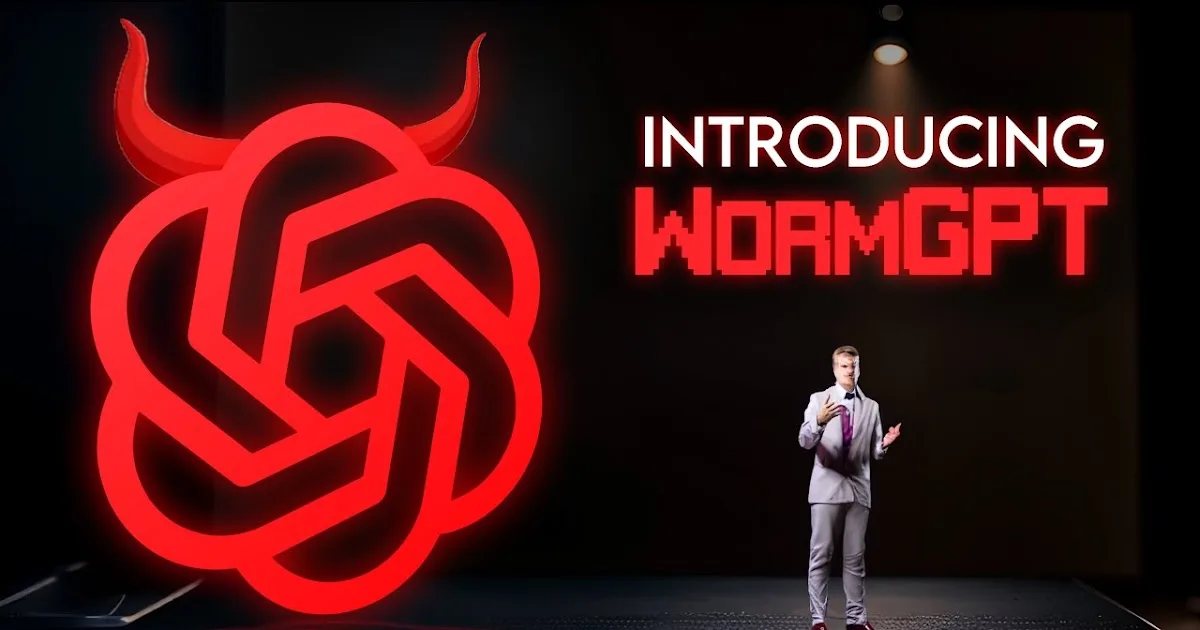
The tool that started it all. WormGPT appeared on underground forums in July 2023, marketed as "the blackhat alternative to GPT." Built on the open-source GPT-J model, it was specifically fine-tuned on malware-related data and designed to generate business email compromise (BEC) messages without ethical restrictions. The tool demonstrated that even a relatively small open-source model, when freed from safety alignment, could produce convincing phishing content that outperformed manual efforts.
WormGPT's creator voluntarily shut down the project after intense media attention, but the precedent was set. Within weeks, multiple clones and successors appeared across dark web forums and Telegram channels.
FraudGPT
Appearing almost simultaneously with WormGPT in July 2023, FraudGPT was marketed as an all-in-one cybercrime toolkit. Advertised capabilities included phishing email generation, scam page creation, carding code, and vulnerability scanning. Sold on a subscription model ($200/month or $1,700/year), it exemplified the emerging Cybercrime-as-a-Service (CaaS) model where AI tools are rented rather than sold.
GhostGPT
Identified by cybersecurity researchers in late 2024, GhostGPT represents the evolution of dark web AI distribution. Rather than operating through dark web forums, it operates primarily through Telegram — making it more accessible to less technical users. GhostGPT is marketed for generating malware code, crafting phishing emails, and creating social engineering scripts. It offers anonymous access with no logging and no content restrictions.
PoisonGPT — The Research Warning
Unlike the other tools on this list, PoisonGPT was created by legitimate cybersecurity researchers at Mithril Security as a proof-of-concept. It demonstrated how an attacker could take a popular open-source AI model, inject false information into its knowledge base, and redistribute the poisoned version — a supply-chain attack against the AI ecosystem itself. The project highlighted a critical vulnerability: users downloading open-source models from community repositories have no guarantee that the weights haven't been tampered with.
DIG AI — Tor-Hosted Chatbot
One of the most notable developments of 2025 is DIG AI, an AI chatbot accessible exclusively through a Tor hidden service. Unlike Telegram-based tools that operate in a gray area, DIG AI is hosted directly on the .onion network, offering unrestricted AI access with no registration, no logging, and no content filters. It represents the logical endpoint of the dark web AI trend: a fully anonymous, censorship-resistant AI service operating outside any jurisdiction's reach.
DIG AI — Tor AI Chatbot
How Dark Web AI Tools Work
Wrappers vs. Fine-Tuned Models
The vast majority of dark web AI tools are not original models. They fall into two categories:
- Jailbroken Wrappers: Interfaces built on top of existing models (GPT-4, Claude, Gemini) that use carefully crafted system prompts to bypass safety filters. These are the simplest and most common. The "tool" is essentially a pre-loaded jailbreak prompt attached to an API call
- Fine-Tuned Open-Source Models: Open-source models (LLaMA, Mistral, GPT-J) that have been intentionally retrained or had their safety alignment removed. These require more technical skill to create but produce genuinely uncensored models that operate without any guardrails
Distribution Infrastructure
Dark web AI tools are distributed through multiple channels:
- Telegram: The primary distribution channel for tools like GhostGPT. Private channels offer subscription access with cryptocurrency payments
- Dark Web Forums: Dread, Exploit.in, XSS.is, and BreachForums host advertisements, reviews, and vendor profiles for AI tools
- Tor Hidden Services: Services like DIG AI operate as standalone .onion websites with web-based chat interfaces
- Subscription Models: Pricing typically ranges from $50 to $200 per month, with some tools offering lifetime access for $1,000+
The Scam Problem
A critical and often overlooked reality: many dark web AI tools are themselves scams. Cybersecurity researchers consistently report that a significant portion of advertised "dark GPT" tools are simple wrappers around freely available models, sold at premium prices with minimal additional capability. Some are outright fraud — collecting subscription payments and delivering nothing. The dark web AI market is plagued by the same trust problems that affect every other underground marketplace. Buyer beware applies doubly when the product itself is designed for deception.
Uncensored LLMs and Open-Source Exploitation
The ULLM Ecosystem
Beyond purpose-built criminal tools, a parallel ecosystem of Uncensored Large Language Models (ULLMs) has emerged. These are open-source models — typically based on Meta's LLaMA, Mistral, or similar architectures — that have had their safety alignment deliberately removed by community contributors. Unlike dark web tools sold for profit, many ULLMs are freely available on model-sharing platforms.
The process is technically straightforward: take a safety-aligned model, fine-tune it on a dataset that reverses the alignment training, and republish. The resulting model will comply with any request without ethical filtering. While some ULLM creators argue for legitimate use cases (creative writing, research), the security implications are substantial.
Legitimate vs. Malicious Tools
Not all AI tools associated with the dark web are malicious. Important distinctions exist:
- DarkBERT: A legitimate research model developed by academics, trained on dark web text data for defensive cybersecurity intelligence. It is used by researchers to analyze and understand dark web content, not to generate it
- HackerGPT: A legitimate penetration testing tool designed for authorized security professionals. It assists with vulnerability discovery and exploit development within legal, ethical bounds
- Uncensored LLaMA variants: Gray-area models that remove safety filters but are primarily used for non-malicious purposes like unrestricted creative writing or research
Model Security — Weights vs. Prompts
A common misconception is that frontier models like GPT-4 or Claude have been "stolen" and redistributed on the dark web. No confirmed theft of frontier model weights has occurred. The distinction matters:
- System Prompt Extraction: Attackers can sometimes reveal a model's hidden system instructions through jailbreak techniques. This exposes configuration details but not the model itself
- Model Extraction Attacks: Researchers have demonstrated that querying an API repeatedly can produce a distilled "clone" that approximates behavior, but this creates an inferior copy, not the original
- Weight Theft: Actually stealing the trained parameters of a proprietary model would require breaching the developer's infrastructure — a fundamentally different and far more difficult attack vector
Impact on Cybersecurity
The proliferation of dark web AI tools has fundamentally altered the cybersecurity threat landscape in several critical ways:
- Lowered Barrier to Entry: Sophisticated cyberattacks that once required years of technical training are now accessible to novice attackers. A user with zero coding experience can generate functional malware, convincing phishing emails, or social engineering scripts using dark web AI tools
- Scale and Automation: AI enables attackers to generate thousands of unique, personalized phishing messages in minutes — a task that previously required teams of human operators. Each message can be tailored to the target's specific context, making detection significantly harder
- Polymorphic Malware: AI-generated malware can be automatically mutated to evade signature-based detection. Each generated sample is unique, rendering traditional antivirus approaches less effective
- Enhanced Social Engineering: AI-powered voice cloning and text generation enable real-time impersonation attacks. Combined with data from breached databases, attackers can create hyper-personalized deception campaigns
- Defensive AI Response: The security industry has responded with AI-powered defenses: behavioral analysis, anomaly detection, automated red-teaming, and AI-assisted threat hunting. The result is an escalating arms race between offensive and defensive AI capabilities
Timeline — AI on the Dark Web
| Date | Event | Significance |
|---|---|---|
| Nov 2022 | ChatGPT launches publicly | Generative AI becomes mainstream overnight |
| Dec 2022 | First DAN jailbreaks appear | Community discovers role-play bypasses safety filters |
| Q1 2023 | DAN 2.0 through 5.0 iterations | Rapid cat-and-mouse evolution of jailbreak techniques |
| Jul 2023 | WormGPT and FraudGPT emerge | First purpose-built criminal AI tools sold as subscriptions |
| Aug 2023 | DarkBARD, XXXGPT reported | Rapid proliferation of dark GPT variants across forums |
| Late 2023 | WolfGPT; PoisonGPT research published | Code obfuscation tools; supply-chain attack proof-of-concept |
| 2024 | GhostGPT, EscapeGPT; crescendo attacks | Telegram distribution; sophisticated multi-step jailbreaks |
| 2025 | OWASP LLM Top 10; DIG AI launches | Prompt injection ranked #1 vulnerability; first Tor-native AI chatbot |
| 2026 | Agentic attacks; hybrid exploits | AI agents as attack vectors; defense-in-depth era begins |

The Future of Dark Web AI
Based on current trajectory and threat intelligence analysis, several developments are anticipated in the near-term evolution of dark web AI:
Autonomous Attack Agents
The most significant anticipated shift is from generative tools (AI that creates content on request) to autonomous agents (AI that executes multi-step operations independently). Future dark web AI tools will likely perform entire attack chains — reconnaissance, vulnerability scanning, exploit generation, payload delivery, and data exfiltration — with minimal human oversight. The technology for this already exists in defensive security (automated penetration testing); its migration to offensive tooling is inevitable.
Real-Time Deepfakes on Demand
Voice cloning technology has already reached the point where a few seconds of audio can produce a convincing replica. As real-time video generation improves, dark web services offering on-demand deepfake capabilities for social engineering — phone calls from "executives," video verification bypasses, identity fraud — will likely become commoditized services sold alongside existing AI tools.
Decentralized AI Inference
Current dark web AI services have a single point of failure: the server hosting the model. The next evolution is distributed inference networks — running uncensored models across peer-to-peer infrastructure where no single node can be seized or shut down. Projects exploring decentralized AI computation are already in development on the clearnet; their adaptation for censorship-resistant dark web use is a natural progression.
AI-Powered Market Infrastructure
Beyond offensive tools, AI will likely reshape darknet marketplace operations themselves: automated vendor bots handling customer service, AI-driven escrow dispute resolution, dynamic pricing algorithms, and predictive logistics for delivery optimization. Markets that integrate AI-powered automation will gain significant operational advantages.
The Regulatory Response
The EU AI Act (enforced from 2025) introduces specific provisions around AI safety circumvention. Future regulation may explicitly criminalize the distribution of jailbreak techniques or uncensored model weights. However, enforcement against anonymous Tor-hosted services remains a fundamental jurisdictional challenge. The regulatory landscape will likely drive a sharper divide between clearnet AI (increasingly restricted) and dark web AI (increasingly unrestricted).
Convergence with Cryptocurrency
The intersection of autonomous AI agents and cryptocurrency creates a particularly potent combination: AI systems with the ability to independently hold, transfer, and launder digital currency. Autonomous agents capable of executing financial transactions without human intervention represent a qualitative shift in the threat landscape — from AI as a tool used by humans to AI as an independent economic actor.
Editorial Note: The predictions above are based on current technological trajectories and published threat intelligence. The actual evolution of dark web AI will be shaped by unpredictable factors including law enforcement operations, open-source model governance decisions, and the ongoing arms race between offensive and defensive AI capabilities.
Frequently Asked Questions
What is WormGPT?
WormGPT was one of the first purpose-built dark web AI tools, based on the open-source GPT-J model. Launched in July 2023, it was designed to generate phishing emails and business email compromise (BEC) content without ethical guardrails. The creator voluntarily shut it down after media exposure, but clones and successors continue to circulate on underground forums and Telegram channels.
What are dark web AI tools used for?
Dark web AI tools are primarily used for automating cyberattacks: generating phishing emails, writing malware code, creating scam pages, crafting social engineering scripts, and producing deepfake content. Most are wrappers around existing open-source models with safety filters removed, sold as subscription services on dark web forums and Telegram.
Is jailbreaking AI illegal?
Jailbreaking AI exists in a legal gray area. Simply bypassing content filters through prompt engineering is generally not illegal per se, but using jailbroken AI to generate malware, fraud content, or other illegal material constitutes criminal activity in most jurisdictions. The EU AI Act (2025) introduces specific provisions around AI safety circumvention that may further restrict jailbreaking practices.
What is the difference between jailbreaking and prompt injection?
Jailbreaking targets the model's ethical guardrails — making it generate content it was trained to refuse. Prompt injection exploits the model's inability to distinguish developer instructions from user input, allowing attackers to override system prompts, exfiltrate data, or force unintended actions through APIs and AI agents. Prompt injection is ranked #1 in the OWASP Top 10 for LLM Applications 2025.
Are dark web AI tools actually effective?
Many are scams themselves — simple wrappers around free models sold at premium prices. However, some tools provide genuine uncensored access to powerful models, and even basic jailbroken wrappers can significantly lower the barrier to entry for phishing and social engineering attacks. The effectiveness varies enormously by tool.